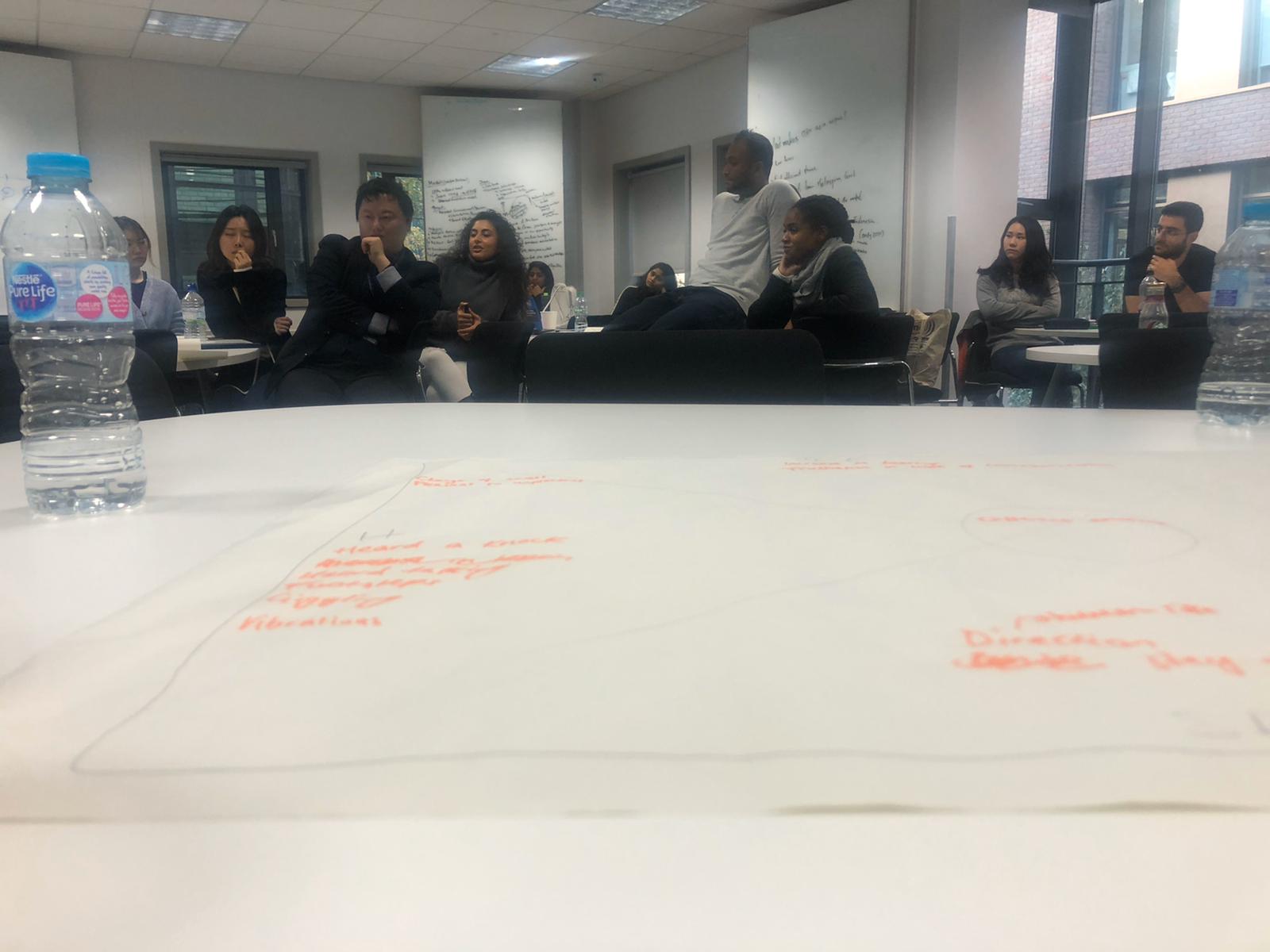
The design thinking class has been one of the most insightful since I joined the master’s course. Design thinking is an important antecedent of innovation, and I consider it one of the most vital courses I have taken. According to Chasanidou, Gasparini, and Lee (2015), design thinking comprises of desirability, viability, and feasibility, which have a positive impact on innovation. Actually, design thinking is being regarded in many organisations and universities as ‘the secret weapon for innovation’ (Prud’homme van Reine, 2017, p.56). In this blog, I will share with all of you an activity that we did in the design thinking class and the lessons I learnt.
Jihun, Mai and I played a game where one of us was assumed to be blind, the other played mute, and the other a robot. The aim of the game was for the mute and the robot to lead the blind to the bathroom. Clearly, the blind does not have the sense of sight, the mute cannot talk, and the robot can only follow instructions. Therefore, we had to stand in various places and help each other reach the ultimate goal. The mute observed everything for us, and the blind was very careful to use the sense of touch and that of hearing to move around. Although the exercise sounds easy and exciting, it was not simple. There were noises all around us and at times, I can admit that I got confused on what to do. However, I am really glad that we accomplished our goal of leading the blind man to the bathroom.
The rather awkward game, mute, robot and blind exercise, showed very informative to me on the core and nature of design thinking. Certainly, the exercise posed a challenge to us that we had to overcome with very limited capabilities at hand. To succeed, we had to use design thinking, which is the skill used in solving problems by creating and evaluating innovative ideas. Design thinking requires that one understands a given problem, the people involved, and creatively develop ideas to solve such issues. I am really glad that we did the exercise in class because it has helped me to understand design thinking better, and especially in its application to entrepreneurship. According to Val, et al. (2019), the paradigm of entrepreneurship education in Europe has shifted towards design thinking, since it helps students to conceive new realities, and it therefore provides a foundation for innovation, self-confidence, and problem solving. As a future business executive, I hope to improve my entrepreneurial skills by adopting design thinking, which will help me in understanding the marketplace, identifying roles, and developing innovative products/ services to meet the needs of the market. I am really glad that design thinking can be used in any industry, for any product, and even in solving real-life problems. I really learnt a lot from the mute, robot and blind exercise, and I hope you have all learnt something from my blog post. Thank you.